
Home/products/Vegetables/Calabash_Bottle Gourd
Bottle gourd (Calabash) nutrition facts
Bottle gourd or calabash is a delicately flavored, cucurbita family vegetable. It is one of the chief culinary vegetables in many tropical and temperate regions around the world.
Botanically, it belongs to the broad cucurbitaceae (gourd) family of vegetables; in the genus Lagenaria. Scientific name: Lagenaria siceraria (Molina) Standl. Some of common names are white-flower gourd, opo-squash, long squash, etc, in the west and doodhi or lauki in the Indian subcontinent.
|
|
|
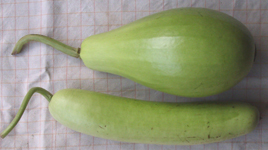
Bottle gourd. Note that round and pear shaped fruits are known as calabash in the west. |
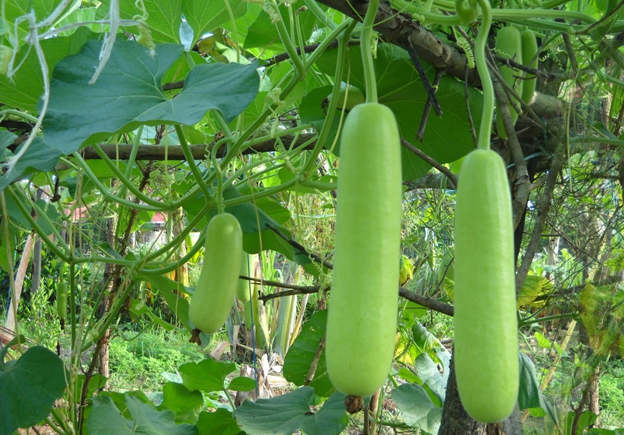
Bottle gourd is a fast growing, annual climber (vine) that requires adequate sun light for flowering and fruiting. It can be grown under wide range of soils and require trellis support for easy spread.
Its intensely branched stems bear musky, deep green, broad leaves just as that in pumpkin and white monoecious flowers in the summer. After about 75 days from the plantation, young, tender, edible fruits evolve that are ready for harvesting.
The fruit features oval, pear shaped or elongated, light-green and smooth surface. In case of round or pear calabash, the surface is marked by incospicuous ridges that run along its lengthwise. The fruits come in wide range of shapes and sizes. Internally, the flesh is white, spongy and embedded with soft, tiny seeds. As the fruits begin to mature, they gradually develop to bigger size similar as that in honeydew melons.
Health benefits of Bottle
gourd
|
Principle |
Nutrient Value |
Percentage of RDA |
|
Energy |
14 Kcal |
<1% |
|
Carbohydrates |
3.39 g |
2.5% |
|
Protein |
0.62 g |
1% |
|
Total Fat |
0.02 g |
0.5% |
|
Cholesterol |
0 mg |
0% |
|
Dietary Fiber |
0.5 g |
1% |
|
Vitamins |
|
|
|
Folates |
6 µg |
1.5% |
|
Niacin |
0.320 mg |
2% |
|
Pantothenic acid |
0.152 mg |
3% |
|
Pyridoxine |
0.040 mg |
3% |
|
Riboflavin |
0.022 mg |
2% |
|
Thiamin |
0.029 mg |
2.5% |
|
Vitamin A |
16 IU |
0.5% |
|
Vitamin C |
10.1 mg |
17% |
|
Electrolytes |
|
|
|
Sodium |
2 mg |
<1% |
|
Potassium |
150 mg |
3% |
|
Minerals |
|
|
|
Calcium |
26 mg |
2.6% |
|
Copper |
0.034 mg |
4% |
|
Iron |
0.20 mg |
2.5% |
|
Magnesium |
11 mg |
3% |
|
Manganese |
0.089 mg |
4% |
|
Phosphorus |
13 mg |
2% |
|
Selenium |
0.2 mg |
<1% |
|
Zinc |
0.70 mg |
6.5% |
See the table below for in depth analysis of nutrients:
Bottle gourd or Calabash (Lagenaria siceraria),
fresh, raw, Nutritive value per 100 g
(Source: USDA National Nutrient database)
Selection and storage
Bottle gourds are available around the season in the regions wherever suitable conditions for their growth exist. In the markets, look for fresh produce featuring tender, medium size, uniform, light green color fruit. Take a close look of its stem, which may offer a valuable hint whether the produce is fresh or aged.
Avoid those with oversize, mature, yellow-discoloration, cuts and bruise on their surface. Tiny spots on the surface, however, would not lessen their quality.
At home, store them inside the refrigerator set at adequate humidity where they stay fresh for 3-4 days.
Preparation and serving methods
|
|
|
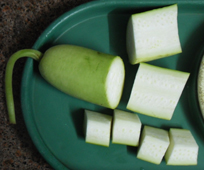
Bottle gourd cut sections. Note for ice-white, spongy flesh, and tiny, incospicuous seeds. |
Bottle gourd is one of the most common vegetable in continuous use since ancient times. To prepare, wash the fruit in cold water and dry mop it using a soft cloth or paper towel. Trim the top end in case of round or pear shaped calabash and either ends in case of elongated bottle gourd. Peeling may not be required in case of tender fruits. Chop the produce into uniform desired chunks for even cooking.
Here are some serving tips:
Safety profile
Some bottle gourds develop naturally occurring cucurbitacins in excess amounts under environmental adversities and accumulate terpenoid toxin compounds such as cucurbitacin B,D,G,H, etc.
Bottle gourd poisoning is a condition that occurs when a raw bitter bottle gourd consumed either directly or in the form of juice. Serious illness and deaths have been reported in India after consumption of bitter bottle gourd juice for its purported health benefits. Symptoms may include vomiting, stomachache, diarrhea occur within minutes of poisonous juice which may follow serious illness like bleeding from gut, shock and death.
ICMR (Indian Council of Medical Research) recommends the following guidelines for bottle gourd consumption for the public:
1. A small piece of bottle gourd should be tasted before extracting the juice to ensure that it is not bitter. If found bitter; the whole fruit should be discarded.
2. Bitter bottle gourd juice should not be consumed at all.
3. Bottle gourd juice should not to be mixed with any other juice.
4. In case of discomfort after consumption (nausea, vomiting, diarrhea or any feeling of uneasiness), the person should be immediately taken to any nearby hospital. (Medical disclaimer).
© wisenatural.in | Images: Wise Natural | Design: Web Team